
C-L-E-A-R: Continuous Learning & Evaluation at Your Club
Part of our nine-part series on AI prompt frameworks for private club leaders
Created with insights from Khizer Abbas and Superhuman AI.
I’ve been thinking a lot about how clubs learn. Not the formal kind—seminars, certifications, conferences—but the way staff teams learn inside the walls of a club. Someone figures something out on the fly. Someone else trains a new hire in a slightly different way. A committee suggests a new wrinkle to a process. None of it is bad, but it’s rarely consistent.
That’s where the C-L-E-A-R Framework helps. It’s simple—Context, Learn, Evaluate, Action, Review—but it gives club teams a way to treat learning like an actual system instead of a reaction.
And like all the frameworks in this nine-part series, its strength really shows when used inside an AI prompt. CLEAR turns a vague request like “Help me improve staff adoption of our reservation software”into a structured learning cycle clubs can actually implement.
Why CLEAR Matters in Private Clubs
Clubs introduce new tools and workflows constantly—court reservation software, event registration tools, CRM updates, mobile apps, even new dining procedures. But staff adoption is often uneven. Member usage even more so.
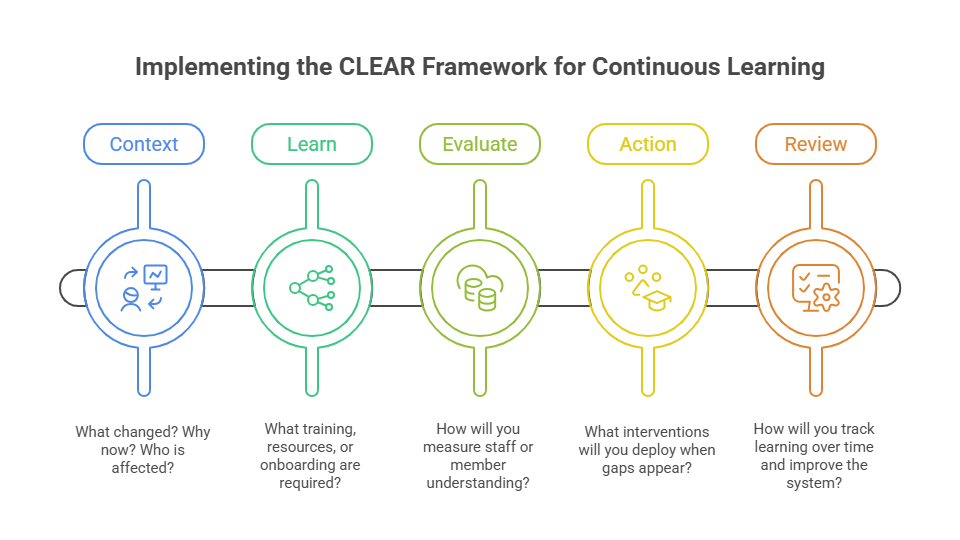
CLEAR breaks the cycle into something repeatable:
I used software rollout as the example because I’ve lived through too many of them. A new reservation module goes live. Staff are told, “It’s pretty intuitive.” A few get it immediately; others struggle silently. Members run into errors. Complaints trickle in. We end up fixing downstream issues instead of addressing the actual learning process.
CLEAR gives managers a predictable loop to prevent that drift.
Walking Through CLEAR at a Club
Context:
Let’s say your club launches a new tennis and pickleball reservation platform. It affects front desk, racquets staff, instructors, and members booking on their phones.
Learn:
Train staff in layers. Not just “how to use the system,” but the most common member scenarios: rescheduling, adding guests, court conflicts, peak-time rules. Staff training sets the tone for member adoption.
Evaluate:
This is where most clubs skip a step. Are you measuring:
Without evaluation you can’t know if learning is actually happening.
Action:
Based on evaluation, deploy targeted help—refresher workshops, short video walkthroughs, a troubleshooting guide at the front desk, or even micro-trainings during shift change.

Review:
The quarterly audit is where long-term learning sticks. Look at usage analytics, satisfaction, and operational friction points. It’s also where you can decide if more training or a process adjustment is needed.
The more consistently you run CLEAR, the more your club becomes a place that anticipates learning needs instead of reacting to them.
Sample Prompt (Copy & Paste Into ChatGPT, Claude, Gemini, or Copilot)
Use this prompt whenever you’re rolling out new software, member policies, operational changes, or training efforts.
**“You are an experienced Assistant General Manager at a private club who has overseen multiple technology and process rollouts across racquets, fitness, dining, and golf operations. You understand how staff learn, how members adopt new tools, and the common failure points during rollout.
Context: Analyze the attached information about our new reservation software and describe the operational areas it will affect.
Learn: Design a staff learning plan, including training modules, FAQs, and hands-on scenarios tailored to how private club teams work.
Evaluate: Recommend practical metrics and tools we can use to track staff proficiency, member usage, and error patterns during the first 60 days.
Action: Based on likely gaps, propose interventions—refresher sessions, quick-reference guides, member tutorials, or workflow adjustments.
Review: Create a quarterly review plan with specific KPIs, audit steps, and recommendations for ongoing improvement.”**
If you’ve ever struggled through a new technology launch at the club, you can see how this prompt forces the model to think in a cycle rather than giving you a generic checklist.
How CLEAR Builds a Culture of Learning
Clubs work best when learning isn’t an event—it’s a habit. CLEAR helps leaders create that rhythm. Each time I use it—whether for software rollouts or re-training a department—I’m reminded how much smoother things go when we’re intentional about how people learn.
Credit: This article is part of a nine-part series created with insights from
Khizer Abbas — https://www.linkedin.com/in/khizer-abbas/
Superhuman AI — https://www.linkedin.com/company/superhuman-ai/
